Wednesday, March 27, 2013

The Atlas (Where I'm Coming From, Part 4)

Yeah, that title's getting recursive. I should probably do something about that.

So in my previous post, I wrote that I rejected Greyhawk for being to, well, uniform in its "Europeaness" and the Realms for having too much meta-plot . . . and that this this led me to reconsider my old Kingdoms of Kalamar material.

In particular, the Atlas.

I'm one of the lucky ones who got a chance to buy the atlas before Kenzerco started publishing primarily through pdfs. It's a beautful piece of work, showing the whole world in a physical map at 25 miles per inch and at 500-1000' elevations. Not only the major cities and towns, but every single village with more than 500 people, every major road and minor path, every navigable river and major creek is shown in glorious detail.

Only the major geographic details (i.e., those shown and labeled on that original air-brushed maps) are labeled, so there are plenty of rivers and hills with no name, and plenty of potential small forests and swamps for the DM to place as he sees fit.

Basically, it's the same scale as the Forgotten Realms' maps of the Dalelands and the Sword Coast, but for the whole continent.

I've found two downsides to the level of detail in the Atlas. First, it takes a bit more work to drop in a pre-made module (other than those made for KoK, of course). I can usually find a place that looks close enough to the area described in a module, but it does take a bit of re-working, something changing distances or fudging what I see on the map to drop in a marsh or whatever. That's not terrible, but it does mean that I can't just drop in locales fresh "out of the box."

The second problem is that the level of "realistic" detail necessarily defines the sort of campaign you're going to run. This can be good or bad depending on what you want.

On the bad side, if you want to run a rather gonzo exploration campaign defined by epic and strange landmarks, KoK may not be for you. This is a bit of a damper on my enthusiasm on those days when I want to create a wierd hexcrawl campaign that runs on the same kind of logic as your standard megadungeon does, the rule-of-fun and rule-of-interesting trumping realism.

On the good side, if you want to run a campaign that proceeds from the versmilitude of a realistic setting, the Atlas combined with the Sourcebook does all of the high-concept work for you--including giving the broad strokes of the weather patterns, area resources, major trade routes, etc.--and then zooms in so as to do a lot of the local work as well. You don't have to come up with names for every settlement; the Atlas does it for you (which can be bad, but I'll deal with that in a later post).

So how do you fit that with the rather high-fantasy assumed in the B/X D&D books? Here, I think we need to look again at the concept of alignment, which deserves its own post, but also with a post over on the Greyhawk Grognard blog from a few years ago:

In some sandbox-type settings, the idea is to explore a wilderness and "clear it out", much like some players are inclined to "clean out" a dungeon or dungeon level before moving on. But the World of Greyhawk fantasy setting, much like the concept of the megadungeon itself (which largely had its genesis in Greyhawk) works a little bit differently. Those "empty" hexes are only empty in the context of adventurers looking for stuff to explore and things to kill. Simply put, in the civilized lands of Greyhawk (and even in the barbarian lands in the northern belt of the map) you're not supposed to go into a given hex with the idea that it is a new realm to be tamed, its inhabitants slain and its lands brought into the sphere of civilization. In many respects, it's just another part of the montage of travel, flyover country where you must travel by necessity in order to get to your ultimate destination. . .  [I]n a setting such as Greyhawk, the theme is not "exploring the wilderness, taming it, and bringing it to the realm of civilization". It's "there are elder places of deep and abiding mystery, which we reach by passing through relatively mundane spaces."
And so it is with Tellene. As it turns out, the maps have a surprising amount of area that is untamed, but even within major civilized areas like the Kingdom of Kalamar itself, there are pockets of wilderness that man has never been able to claim, or else has claimed and lost again to the forces of Chaos. These areas become even more evident with the Atlas's insistance on marking every outpost with more than 500 people--you can see exactly where civilization ends and the true wilderness begins.

In a future post, I'll talk about how I came about restructuring the nine-alignment system assumed by KoK (a holdover from D&D) into the three-fold structure of B/X, and how that impacts my understanding of the world of Tellene. But first, let me finish explaining why I came back to Kalamar.

Saturday, March 9, 2013

Return to Kalamar (Where I'm Coming From, Part 3)

So why exactly did I want to play a B/X D&D campaign in Kalamar?

Well, the B/X part was pretty easy. I'd already introduced a group of young players to a mix of Holmes and Mentzer's Expert set, but the lack of legal copies of the rules was hampering to some. The release of legal pdfs of B/X made it possible to not just play a good retroclone of D&D (as good as Labyrinth Lord is), but actually introduce the next generation to the game I grew up with.

All I needed was an initial setting for the campaign.

Here, I have to admit, my "gamer's ADD" was the main problem. As I got back into reading the old fantasy novels that I hadn't given away (precious few of the ones I kept were "game" novels, thank God) and started picking up some of the works in Gary Gygax's famed "Appendix N," I found myself veering back and forth between possible settings for the game, from a kind of fantasy version of ancient Israel lying on the borders of a magitek/steampunk empire, to a Borderlands campaign (ala B2: Keep on the Borderlands) set in a medieval Poland based heavily on Poul Anderson's Three Hearts and Three Lions, to a gonzo fantasy campaign based on Grimm's fairy tales and the Dungeons & Dragons cartoon show . . . I just kept jumping around from idea to idea, map to map. Had I the time, I might have even tried to patch them all together Golarion-style (and my hats off to Paizo for that setting, btw), but the responsibilities of work and family (including a new baby) just weren't giving me that time.

It probably didn't help my limited time that I was during that same period immersing myself in the writings of the various blogs and boards of the OSR: Grognardia, Bat in the Attic, B/X Blackrazor, Blood of Prokopius,  the OD&D Discussion Boards, Philotomy's now-defunct site, etc. Had I been able to obtain legal copies of Gary and Dave's original rules, I don't doubt for a moment that I would have started up a game, but alas, I missed the window of opportunity there.

Eventually, it came down to the old addage, "Fish or cut bait." I could spend years studying OD&D, data-mining the rules for clues about its assumed world, philosophizing, endlessly editing my own house rules, and endlessly creating still-born campaign worlds . . . or I could play.

The re-release of the B/X rules settled the rules issue--I could house-rule and create new races and classes to my heart's content, but I had a basic ruleset to start from--but I still had the problem of needing a setting.

I needed a world with a lot of different cultures and situations so that I could indulge my gamer ADD (transitioning the characters from region to region instead of coming up with a new world every week). That leaned against doing Greyhawk, which is pretty much a swords & sorcery mirror-universe of Europe. That's not bad, of course, just not what I needed to satisfy all of my cravings at once.

The Forgotten Realms was a second choice that came to mind. I still have all the materials of my original gray box, though I sadly lost many of the add-ons in subsequent moves. (Losing The Savage Frontier hurts the most, I think.) My biggest problem with the Realms is that after literally decades of novels and modules and a vast overarching metaplot . . . I really don't see any way to make it my own. Granted, I could've just declared that nothing after the gray box was canon, unless I wanted it to be (I liked many of the early novels), but . . .

So that led to me digging back out my Kingdoms of Kalamar material and reading it over. And despite some of the names not really scratching my Tolkien/Greenwood itch, I found myself falling back in love with the setting again.

To be continued . . .

Sunday, February 24, 2013

Discovering Kalamar (Where I'm Coming From, Part 2)


It was in the summer of '94 or '95 at DragonCon that I came across a table in the dealer room on which was spread out one of the most beautiful fantasy maps I had ever seen. Curious, I took a step over and struck up a conversation. Ten minutes later, I walked off with a box containing the map (in two halves) and two small booklets that I have poured over ever since.
Here, creatures of dark evil roam the lands in search of prey, while others rule a terrified populace from the safety of their throne rooms. Meanwhile, elven warriors battle expansionist human kingdoms to protect their forest homes, dwarven rebels plot the overthrow of their human conquerors, and the armies of hobgoblin kingdoms grow increasingly powerful.

Spies and spellcasters seek knowledge and power for themselves and those they serve, and strands of their web-like plots reach into cities and towns across the continent. Ruins of ancient empires lie buried beneath burning desert sands, and their stories told in smoky back rooms attract brave fools eager for excitement and quick wealth. The streets are full of the brave and foolhardy, eager to draw steel and strike for little cause, and war between kingdoms is a constant occurrence. The courts of the nobility also hold mystery and intrigue, provided one can master social pressures greater than the threat of a giant’s club or a dragon’s fang.

All this and more awaits you in the Kingdoms of Kalamar, for use with Dungeons & Dragons® and other fantasy gaming systems. (From Kenzerco's website)
I didn't start a campaign in Kalamar at that time, mostly because I was already involved in a long-standing homebrew. I did however find quite a few pieces of inspiration in the Kingdoms that I stole for my world and happily bought the 3rd Edition D&D books when they came out.

Now, I can understand why a lot of people dismiss the setting as "vanilla." It's actually designed that way in the vein of Greyhawk and the Forgotten Realms: A world where the DM (GM) can drop in just about anything, set his characters up in just about any Western to Near-Eastern culture, and be ready to go. That is not, in my mind, necessarily a bad thing. After all, D&D is itself a very Western to Near-Eastern game, tapping into the collective legends and archetypes of this part of the world (including, interestingly, the American archetype of the savage frontier). A "vanilla" setting is just a way for the DM to jump past the large-scale world design and into the small-scale adventure and mid-scale campaign design.

However, even the vanilla settings had their own niches and flavors. Greyhawk was a pseudo-Medieval Europe (including knights and a bazillion types of pole-arms) but with pockets of ruins and lost civilizations, free cities of intrigue, and monsters that gave the edges of civilization a definite sword-and-sorcery vibe. The Forgotten Realms, on the other hand, had a very high-fantasy, Tokienish feel, with names that would have been at home in Sindarin, a Northland of scattered city-states separated by leagues upon leagues of untamed wilderness, and numerous evil domains that required strong heroes to hold them back, even for a time. (I'm leaving out Dragonlance for now because it's niche was mostly its meta-plot and the ability of the players to run through it.)

So what is Kalamar's niche? In a word, it feels real.

The setting's strength was that it was at its core a low-magic or at least rare-magic world. There were certainly powerful wizards about, but the fairly deep history provided only gave a handful of instances where events turned on some wizard's magic (such as the elven king cursing the King of Brandobia with fertility, resulting in triplets tearing the kingdom apart). For the most part, kingdoms rise and fall by the sword, not by the spell, the underlying philosophy being that it's easier for a DM to add magic to a setting than to take it away. Therefore, the geography and history, though of course vastly different than earth's, are kept deliberately "realistic," giving one a good base from which to extrapolate additional history and future events. Magic is very much a part of the setting, but is kept subtle enough in the core material that the GM has plenty of room to add it, without having to remove any core elements like airships, wizards' conclaves, or world-shaking cataclysms if he doesn't want them in there.

I have to admit, I really loved this setting.
The other core element that makes Kalamar an excellent campaign setting is the commitment of its designers to never advance the timeline or add any meta-plot. Unlike Greyhawk, there is no continent-wide war whose outcome has been pre-determined, and unlike the Realms, there is no Time of Troubles in which the gods walked among men and changed the course of history. The world is the setting for your campaign, not somebody else's. And frankly, as a DM who loved the Realms grey box but detested the Avatar Trilogy and everything that followed, that's a wonderful thing.

Sadly, despite the lack of meta-plot, there were some changes (or at least some development directions) that were forced upon the Kingdoms of Kalamar when it became an official setting for 3rd Edition. The necessary "crunch" quota for a 3rd Edition setting (races, classes, prestige classes, feats, etc.) took KoK in some directions that I never felt really suited it. By attempting to make the setting fit with 3e's assumptions, the world lost much of its rare-magic charm, a subject that I'll return to in a future post.

So why return to Kalamar? Well, that's another post in the making.

Friday, February 15, 2013

On (Re-)Discovering D&D (Where I'm Coming From, Part 1)

Yeah, that's the one.
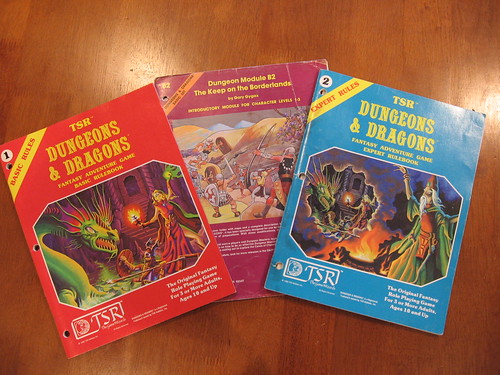
So it's 1986 (too old for true Old School credit, I suppose) and I'm ten years old and over at a friend's house, the parents down stairs visiting, and he pulls out this red box with an amazing picture of a guy charging a great red dragon with the title Dungeons & Dragons written in elegant font across the top and asks if I'd like to learn how to play. After quickly making sure it was cool with the folks (D&D had a reputation even back then) we broke out the three thin books and set of dice he had within and began rolling up my first character, Argos the Acolyte.

I had enjoyed the Dungeons & Dragons cartoon (I don't think I even knew it was based on a game) and had just discovered J.R.R. Tolkien a few months before. (Previously, I'd been working my way through my dad's old Heinlein and Asimov novels, as well as whatever sci-fi I could find in the library.)  D&D opened up to me a whole new world of imagination.

Within the week, I'd acquired my own Mentzer Basic boxed set and within a month I'd also bought the Expert rules. I started running an after-school game with my brother and a couple of friends my mom took care of while their mother was at work. It wasn't a problem, as long as we got our homework done first. I'll freely admit that I went from player to DM way too fast and my first campaign was Monty Haulish at best. After all, it was called Dungeons & Dragons--so surely there must be a dungeon and a dragon in pretty much every adventure, right? Our first characters burned through the levels at a ridiculous pace through a world that looked like Middle Earth via Fantasia from the Neverending Story, with a bit of Greyhawk as read through Gary Gygax's first couple of novels thrown in for good measure. It was glorious, if ultimately silly and shallow, fun.

Eventually, I "graduated" to AD&D, but still often re-read my old BE(CMI) rulebooks. At some point I misplaced my Basic books (during one of my many moves as an adult), but I held onto my Expert rulebook and an old copy of Holmes' that my aunt and uncle had stashed away.

Fast forward a whole lot of years . . .

So, yeah, I've played AD&D 1st and 2nd edition, D&D 3rd Edition, and briefly played 4e. And in the process I've discovered a few things:
  1. It's really hard to get other adults, or young children like my daughter, into the complexities needed for a 3rd Edition campaign.
  2. I myself just don't have the time that it takes to run a 3e game anymore.
  3. Nor do I have the free cash to pick up 4e, even if it's what I was looking for in a D&D ruleset (it isn't).
  4. There are all of these wonderful OSR blogs, sites, and games out there to pick up.
So I spend a lot of time playing with rules-sets, design philosophy, and even making a couple of abortive blogs. But nothing really seems to be coming together.

And then WotC (or Hasbro, I guess) finally does something I've been wanting without knowing how much I wanted it: They re-released the Marsh/Cook Basic/Expert D&D rules.


Despite the aesthetic differences, this is the exact rules set that I started with 27 years ago. And they're back in a perfectly legal form that my players can buy for themselves (those who want to have their own copies).

You know, I think I'm going to play some honest-to-goodness D&D.