Saturday, January 24, 2015

Migrating For Loot and Plunder

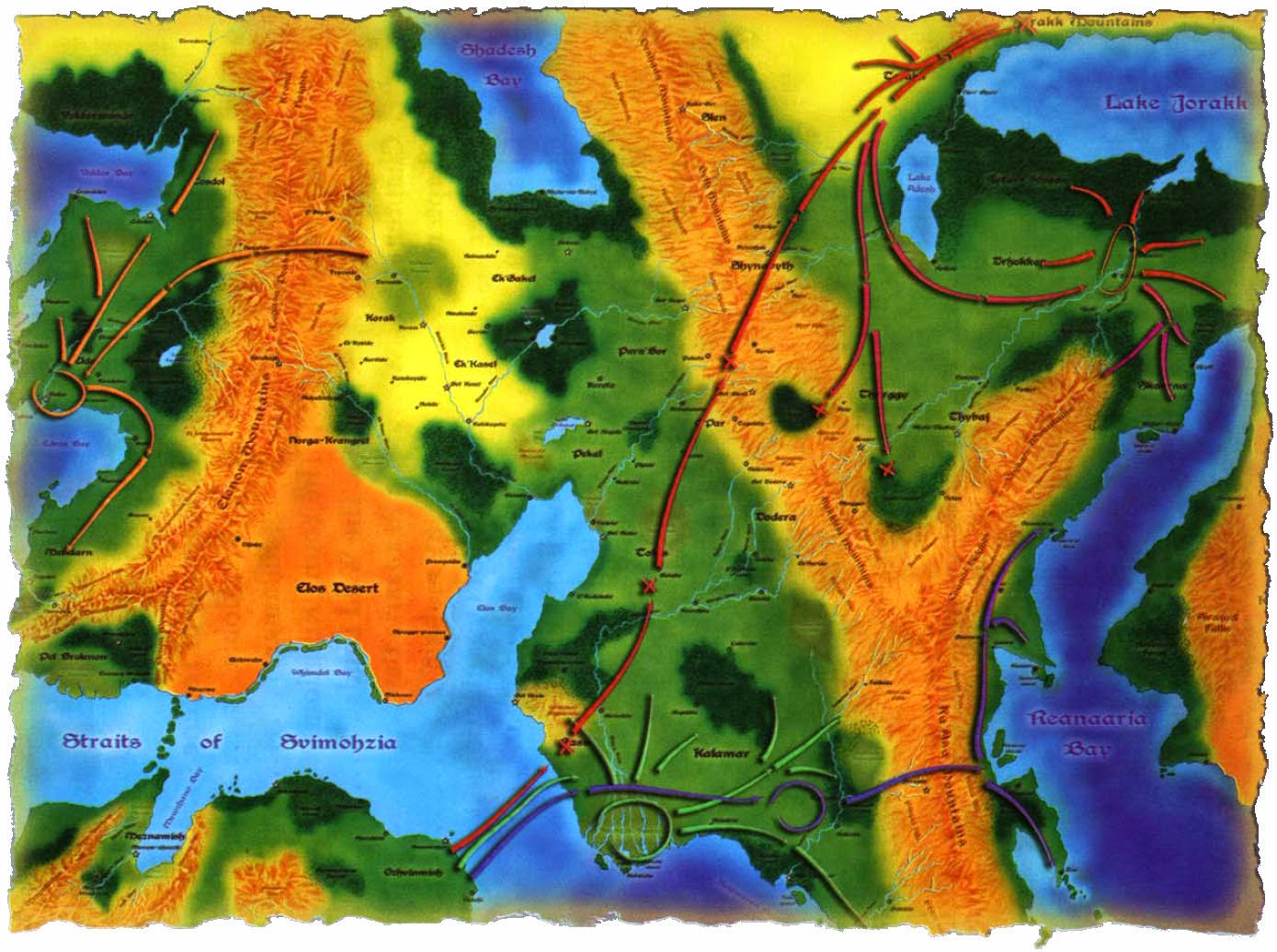
Tellene's rich backstory includes a prehistorical legend about how the various human tribes--the Brandobians, the Fhokki, the Reanaarians, and the Kalamarans--migrated from Svimolz, the Cradle of Civilization after the collapse of the half-forgotten Dejy Empire. The backstory is that the Traveller and the Storm Lord warred over thousands of years, building and destroying a land bridge from Svimolz to the mainland, as the human races migrated one-by-one onto the continent. It's not a bad prehistory, giving you a sense (especially as you read the rest of the sourcebook) of the temperaments and movements of the races, including a sense of where one might find the ruins of their old kingdoms.

There's just one problem: For some reason, all of these great movements (with a couple of exceptions that I'll get to in a moment) take place in Tellene's prehistory. Once the races settle in their various areas, they seem inclined to just sit there.

That's neither particularly realistic nor particularly interesting, from a campaign-world design perspective. There are a couple of reasons for this.

First, KoK--like most D&D worlds--is a pastiche of ancient history and Medieval European culture. In Kalamar's case, there are actually "time" zones one can pass through, from Brandobia (14th Century Europe, or thereabouts), to the Young Kingdoms (Early Medieval Europe, aka the "Dark" Ages), to Kalamar proper (late Roman Empire, or the Byzantine Empire, depending on your preference), to Reanaaria Bay (the pre-Roman Iron/Bronze Age). But Middle-Ages Europe was profoundly impacted by two elements that KoK lacks: The rise of a universal Church that worshiped a single God, and the mass migrations of the Germanic tribes and later the steppe peoples (the Huns, Mongols, etc.). 

As an aside, those interested in this area should check out Dan Carlin's Hard Core History podcast, particularly "Thor's Angels" and "Wrath of the Khans." Carlin has a great "voice" when talking about history, and really knows his material. Also, he tends to rotate his podcasts so that older ones are replaced by newer ones, so get them while they're hot.

In any case, despite being a late Roman culture and the Young Kingdoms being a Middle Ages culture, neither Kalamar nor the Young Kingdoms have ever experienced a mass migration of the Fhokki or the horse-nomad Dejy from the Wild Lands, even when Kalamar was so weakened politically and militarily that its outlying provinces just quietly broke away. Neither do we have any indication that Svimolz used the chaos of the Age of Great Anguish (c. 89-171 in the Imperial Reckoning) or Time of Misfortune (c. 228-236 I.R.; the "start" date of KoK being 563 I.R.) or the long, slow loss of Kalamaran dominance to try to establish its own colonies on the mainland. Why not?

The only real migratory movements noted in modern history are in the Young Kingdoms: The Brandobian conquests in c. -40 I.R., the rise of the hobgoblin kingdom of Kruk-Ma-Kali from 22-35 I.R., and finally the Kalamaran conquests from 41 I.R. on. The Atlas shows that there is still a minority Brandobian presence in the Young Kingdoms by the occasional village with a distinctly Brandobian name. (One thing that I do truly love about KoK is the attention Kenzerco paid to those kinds of details.) That's pretty much it.

And again, that's boring--and not particularly realistic. At the very least, even if they didn't try to hold territory, we would expect waves of Fhokki, Dejy, and Svimolz raiders hitting all of Kalamar's outlying districts during the times when the Vast Empire was weak. Okay, granted Kolokar built a "great wall" (Kolokar's Barrier) to try to keep the Fhokki out--but that didn't exactly work for the Chinese against the Mongols, did it? Yet, the entries for Tokis and Dodera say nothing about Fhokki raids leaving their distinct . . . genetic mark on the local populations.

And that's a great pity, especially for a world otherwise so carefully thought out. KoK thrives on grey-and-grey morality, where people can do terrible things while thinking that they're right and justified. What if Emperor Kabori's obsession with conquering the Thars wasn't just a matter of wanting to expand his empire, but because for hundreds of years Thar raiders had raped, pillaged, and burned the Vast Empire's northeastern borders? What if Basir, Tarisato, and southern Pekal had at various times been conquered by Svimolz, and the people had a distinct chocolate tone to their skin as a result? Maybe there are racial tensions in Tarisato due to the lords tending to be lighter skinned "pure" Kalamarans, and the lower classes having the darker skin tones of Svimolz. For that matter, maybe those conditions are reversed in Tokis and Dodera, where pale, freckled skin (a sure sign of Fhokki blood) is looked down on. 

What about the Young Kingdoms? Did they break off just because they could, or because the Empire proved too weak to protect them from Dejy and Fhokki invasions? Maybe many of the nobles are of Dejy and Fhokki blood as a result, even if they identify ethnically as Kalamaran or Brandobian.

None of this contradicts the canonical material. Tellene's history, as detailed as it is, is really quite sparse and mostly focused on the events that directly lead to the nations' current situations (exactly the way most people would remember it, actually). There are vast centuries details in but a few sentences here and there to fill in.

A final note, which ties into my observations in a couple of recent posts: It seems to be taken as a given by the peoples of Tellene that there are and have been since the Godswar exactly 43 gods (well, 42 for those who don't know that the Overlord is loose again). Each of these has certain titles that seem to be universal, and each seems to be known by different proper names by every culture. My own supposition was that those proper names were the names known by those cultures of the last avatar of the gods, who are hypostases (personified traits) of the Creator, platonic ideals of that which they represent. Since the gods represent all that is in the world of Tellene as endowed by its Creator, every culture instinctively knows all of them.

In some ways this is a shame. There is only other commercial D&D world that pays such close attention to the migration of cultures and how they effect the world, and that is Gary Gygax's own World of Greyhawk.


As Rob Conley and the Greyhawk Grognard have both pointed out, you can derive a lot about the cultures of the Flanaess from the simple one-page listing of the gods of Oerth because it contains a single column noting which gods are indigenous to which cultures--and in turn, by paying a bit of attention to the migratory patterns of Oerth's human races, tells you a lot about the cultures, including which gods are likely worshiped in different regions.

Looks like I'm going to have to spend some time figuring out where each god's major temple is, where else they're worshiped, etc. Should be interesting to try to map that to the different racial movements.

Yes, I'm a geek.

Sunday, January 4, 2015

Generalizing Tellene's Regions (First Draft)

A question came up on the Kenzerco Forums, "How do you generalize regions?" Here's my own list, far from complete, just off the top of my head:

Brandobia - 13th-14th Europe as interpreted through both the Matter of Britain and the Matter of France, but with strangely Oriental influences from mysterious Westerlin, across the Brandobian Ocean.

Cosdol - Estcarp from Witchworld, but without the magic being confined to women.

Eldor - Robin Hood era Britain, as seen through the lense of the 1991 version of the movie (the one with Uma Thurman)

Mendarn - Spain/France in the era of the Three Musketeers, with a bit of Argos and Zingara (from R.E. HOward's Hyborian Age)

Pel Brolenon - A forested Mordor and the Blight, mixed with the Seanchan from The Wheel of Time.

Young Kingdoms - Your "standard" sword-and-sorcery D&D realms; a dangerous, half wild land whose history has been shaped by the countless empires that have conquered it, by having the fey Kalalali Forest dominating it, and by the threat of the Krangi.

Ek'Gakel - the American Old West as seen through Clint Eastwood movies, but with swords instead of guns.

Korak and Ek'Kasel - Rohan and Gondor, holding back the Dark One from devouring the world.

Pekal - The Dalelands of the Forgotten Realms and Valdemar, with a bit of an Arabic twist (due to the influence of the Elosi), but in the throes of societal change due to the influences of the elves.

Paru'Bor - A lone bastion of true Law in a Chaotic world (basically, the setting of The Keep on the Borderlands); Cormyr from the Forgotten Realms; the origin of the word "Paladin" (Paru'Diin).

Elos Desert - Arabia through the eyes of 1001 Arabian Nights and Weis and Hickman's The Rose of the Prophet.

Prompeldia - Greyhawk

Kalamar - the late Roman Empire (3rd-4th Century), striving to regain its former glory

Tokis - Pre-Revolutionary France, ala the Brotherhood of the Wolf

Tarisato - Colonial Africa, if the colonists were Roman instead of British

The Wild Lands - Romanish Germany, Skyrim, the North of the Forgotten Realms, Eriador of Middle-earth, Norse and Celtic legend.

Dhrokker - Mostly Skyrim, but with a significant number of Huns/Mongols/Horselord Dejy roaming the countryside.

Torakk - Northern Skyrim and Cimmeria mixed together, with a touch of Rasheman from the Forgotten Realms

Tharggy - Much like Dhrokker, but with the whole Amazon element--one which cannot survive long thanks to simple demographics.

Thybaj - Native American plainsmen, with a touch of central Asian culture

Skarna - Viking-land, heavily influenced by the Thirteenth Warrior

Slen - Iuz from Greyhawk, Angmar from Middle-earth, D'hara from the Sword of Truth series, and the Yuuzhan Vong (sp?) from the later Star Wars novels

Shynabyth - Native American in outward culture (albeit with an advanced metallurgy), but in the midst of a war between atheism and the old spirituality.

Narr-Rytar - Blackmoor

Reanaaria Bay - Early Mediterranean city-states, with the west corresponding to the northern Med and the east corresponding to the southern Med/Saharran/Egyptian region.

Svimolz - Ancient Ethiopia and Africa, inspired by a combination of Shaka Zulu, Afro Samurai, and Tekumel.

Wednesday, December 31, 2014

Twenty Questions

Some time ago, the Necropraxis blog came up with a post entitled "20 Quick Questions: Rules," which was a follow-up to Jeff Rients' "Twenty Quick Questions For Your Campaign Setting." Here are my answers for the Necropraxis questions (I'll do Rients' at a later date, maybe):
  1. Ability scores generation method?
    3d6 in order, then roll 3d6 a seventh time and replace any ability desired.
  2. How are death and dying handled?
    A character can survive negative hit points equal to their level, modified by their Constitution bonus. They lose one hit point per turn until they either make a save vs. death (-1 per negative hit point) or someone intervenes. Below that, make a save vs. death to survive, and even succeeding means rolling for a permanent injury (table to come).
  3. What about raising the dead?
    If you can find a high enough cleric of like alignment and meet their (always steep, both in terms of offering and service) price.
  4. How are replacement PCs handled?
    Promote a henchman (which is a good motivation to have one), bring in an heir who can inherit the former PC's treasures (after a 50% "death tax"), or create an all-new PC at 1st level.
  5. Initiative: individual, group, or something else?
    Group, but having a pole weapon automatically grants initiative in the first round.
  6. Are there critical hits and fumbles? How do they work?
    Double damage on a natural 20, fumbles handled by DM fiat (whatever is the most amusing at the time).
  7. Do I get any benefits for wearing a helmet?
    No, but in any armor heavier than leather, you lose a point of Armor Class for not wearing one.
  8. Can I hurt my friends if I fire into melee or do something similarly silly?
    Yep. If you miss, you have to roll against the PC engaged with your target, rolling as if a zero-level human.
  9. Will we need to run from some encounters, or will we be able to kill everything?
    There will be a lot of running--at least among those who wish to survive.
  10. Level-draining monsters: yes or no?
    Yes, but those so effected may make a saving throw vs. death to recover those lost levels after a week of rest (one roll per level).
  11. Are there going to be cases where a failed save results in PC death?"
    Yep.
  12. How strictly are encumbrance & resources tracked?
    Very strictly, using the Lamantations of the Flame Princess encumbrance rules.
  13. What’s required when my PC gains a level? Training? Do I get new spells automatically? Can it happen in the middle of an adventure, or do I have to wait for down time?
    Leveling happens immediately, though new spells are acquired only after a reasonable period of down time.
  14. What do I get experience for?
    Depends on the adventure. For your standard dungeon-crawl, you get xp for both monsters and loot as per the rules. You get another 2 xp for each silver piece (I use the silver standard) spent. If the adventure involves hunting one or more creatures, you may get up to quintuple the normal xp for kills. For exploration, xp awards for reaching new locations. For epic quests, xp awards for achieving specific goals.
  15. How are traps located? Description, dice rolling, or some combination?
    Some combination. It depends on what the PCs do and the nature of the trap.
  16. Are retainers encouraged and how does morale work?
    Retainers are definitely encouraged, and morale is per the B/X rules.
  17. How do I identify magic items?
    Experimentation, or hiring a magician-sage (very expensive).
  18. Can I buy magic items? Oh, come on: how about just potions?
    Minor magic items can be bought and sold, including potions, +1 weapons, and minor protective charms. Some of these will be counterfeit, of course.
  19. Can I create magic items? When and how?
    In accordance with the BX rules (name level characters) with the following exceptions: Magic-users and elves may create scrolls at any time and potions at 5th level. Dwarves may also create appropriate items (weapons, armor, metal and stone-based miscellaneous items) at name level.
  20. What about splitting the party?
    Sure, go for it. But the encounter tables won't change to save you.

Tuesday, December 16, 2014

Of Gods and Ideals

As I noted in my previous post, the gods of Tellene come across more as Platonic ideals of certain concepts than the gods of earth mythology. In our world's mythology, the gods are personifications of nature, and their emergences, births, wars, marriages, deaths, and so forth are symbolic representations of the forces of nature. For example, it's been speculated that the myth of Baal's death at the hands of Mot (the god of death) in Ugaritic mythology is either a symbolic retelling of the cycle of the year, with the dry summer months of the Levant being reprented by Baal's (the storm-god's) death, or else that the myth was inspired by a particularly harsh drought and famine. My own personal speculation is that the fall of the Titans in Greek mythology was a symbolic representation of the shift in Greek devotion from their old gods to those of the Sidonians / Phoenicians. (The triad of Zeus, Poseidon, and Hades being Hellenizations of Baal, Yam, and Mot.)

Tellene's mythology, as presented in the sourcebooks so far, is fairly static. The gods have personality, but little history beyond a vague war in the past that resulted in the death of eleven of the original fifty-four gods (six per alignment, showing that the "idea" alignment in Tellene is True Neutral--a typical ideal in D&D campaign worlds). There are, as already noted, no relationships between them, beyond all being children of the Creator, though there are alliances and enmities which will surprise no one looking at an alignment chart.

Those tendencies are endemic of campaign worlds developed during the 2e to 3e era of Dungeons & Dragons: Every element must have its opposite, to the point where a salamander (a kind of fire elemental) must be balanced with an "ice salamander" and a paladin must be balanced by an anti-paladin (or blackguard, in 3e). "A foolish consistency is the hobgoblin of little minds" is a phrase that seems to sum it up.

KoK underwent most of its development during this phase, which is somewhat frustrating to me. Ancient mythologies weren't so "balanced," and the symbols of the gods tended to be what was most important to the people in the time that they arose. Some of these seem trite to us. For example, the Mesopotamian god Enlil was symbolized by the mattock. That seems trite and humble to us, but to the stone-age-turning-bronze-age people of Mesopotamia, the mattock was an astounding invention that revolutionized their lives and made agriculture and cities possible.

That actually fits with some of the elements of Tellene pretty well. For example, the Overlord's sacred animal is the draft horse. Sounds trite, until you realize that the Overlord was imprisoned at the dawn of human history, probably at about the same time that humans were starting to domesticate the animals. The draft horse, therefore, becomes a symbol of man's dominance, of taking control of nature rather than being subject to its whims. The Overlord, therefore, was probably the first god of civilization in Tellene.

If so, that tells us something of the moral dimension of Tellene: Dominance, the rule of the strong / high-born over the weak / low-born--or for that matter, the dominance exhibited in domesticating animals--is naturally the province of Lawful Evil, and can never be wholly channeled for Good. On the other hand, tilling the fields and bringing forth crops, represented by the Holy Mother and the Raiser, are inherently Lawful/Neutral Good activities. Conversely, the extreme liberation offered by the Guardian and the wild unpredictability of the Storm Lord are actually more akin to each other than to the tilling of the fields. This is much in contrast to our own world, where the Ugaritic texts viewed Baal as being integral to civilization, as the Levant (unlike Egypt or Mesopotamia) was completely dependent on the winter rains to survive.

The easiest way to reconcile this is that the Holy Mother, Raiser, or Mother of the Elements is the goddess of the gentle rains, and the people of Tellene see a quantitative and moral distinction between rain and storm. One wonders if the Elosi or those of the eastern side of the Reanaaria Bay would have a different view, since a handful of heavy storms a year might be the only rain they get at all . . .

In Greyhawk, the cultures that originated the various gods are noted. No such luck in Tellene: Pretty much everyone seems to know that there are exactly forty-two gods, and every culture has its own name for each and every one of them. While that somewhat offends my own sense of mythology and the possibilities in pagan syncretism for adventures and stories, let's work out the ramifications. The gods each represent "a specific characteristic or related characteristics of the Creator." In other words, they're all what the ancient Greeks would call a hypostasis ("that which underlies," or "essence"): The personified manifestation of some aspect of a god. For Christians, the idea of a hypostasis actually carries over into the Bible as well, which presents Jesus Christ as the incarnate hypostasis of God's Word (John 1:1). Presumably, given that there were originally an even number of deities (six) for each alignment and that the gods were apparently created in opposition to each other, the alignment of Tellene's Creator is either the ultimate in Balance (True Neutral), or else she is simply above such human classifications.

In any case, this to me suggests that while the gods of Tellene have some will and volition, each is basically the personification or hypostsis of those characteristics of the Creator that they exemplify. In some ways, they are more like the Platonic ideal of those concepts than they are living beings: Unlike the gods of Earth's mythologies, they have neither eldest nor youngest among them, nor are they intrinsically connected to each other in families linked by marriages and births. Moreover, in most KoK material, the gods are addressed by their titles rather than their proper names. While I recognize that part of this is keeping things convenient for the DM, I'm going to suggest that it's also an acknowledgement that the gods are more ideals than individuals.

So why do they have names at all? And why do the names rarely seem to be linguistically linked (as in, different pronunciations of the same name, like Baal and Bel, aka Marduk, in our world)?

My personal solution: The names of the gods are the names of the heroes believed to be their most recent avatar to that particular culture. For example, in my version of Pekal, Hokalas isn't just the Riftmaster's proper name, but the name of the human who was the last avatar of the Sorceror Supreme and who established his school in what would become Bet Rogala.

This means that in different times and places, the avatars of the gods would have had different relationships with each other--both in Tellene's literal history and as symbolic unions of these various concepts. This gives me a lot of room to develop Tellene's mythology for my own campaign.

Admittedly, it also gives me more of a chance to cannibalize old campaigns for my Tellene's mythology as well as the chance to have both modern heroes and villains become the new avatars (if the campaign reaches that level).


Thursday, December 11, 2014

The Inherant Vapidness of Mythology in D&D

One of my deep-seated dissatisfactions with most D&D campaign worlds is the way the gods are presented. For some reason, each world is content to give you a couple of pages of deities with a brief description of their alignments and spheres of influence. Second edition AD&D tried to spruce this up a bit by giving clerics distinctive spell lists based on their chosen power, a practice that semi-carried over into 3e.

I can sum up the source of my dissatisfaction in two broad strokes. The first is the ludicrous idea that all gods have clerics. Why on earth would Hokalas, the Sorcerer Supreme, have a priesthood of armored, mace-wielding clerics who have the same spells and ability to turn undead as the clerics of Deb'fo, the Knight of the Gods? Do you know what you call a priest of the god of magic? A magic-user.

While B/X D&D contains rules for chaotic (i.e., evil) clerics--outright called anti-clerics in some editions of the game--the base cleric is a militant champion of Law whose spells and abilities are deliberately drawn from Biblical and post-Biblical Jewish and Christian sources. Clerics are wholly unsuited as the priests of nature gods (that's what druids are for) or gods of magic, thievery, harvests, love and pacifism. The hierarchy implied by their level titles (high-level clerics are presumed to be Patriarchs in their faiths) isn't suited for good but chaotic gods either.

My second problem comes out of my love of culture, religion and mythology. Simply put, there is a richness in real-world religion and its interactions and evolution that is completely lost in most D&D worlds. This is partially deliberate: Gary Gygax was a devout Christian, and while he didn't mind his player's characters interacting with the pulp-fiction version of Thor or Artemis, he didn't want to include anything that he really believed in--hence why there are no stats for Lucifer or Michael in the Monster Manual.

One of the things that I really like about the Kingdoms of Kalamar is that the gods are more than a list or a paragraph. Each one is detailed with their common titles, their names in different cultures, their symbols, their holy days, the kinds of sacrifices their followers offer, the name of their body of believers, and enough details that you can find adventure hooks for every one. It also gives a very basic creation narrative which is pregnant with even more adventuring hooks: An ancient war of the gods, several dead deities, a missing (and possibly imprisoned) Creator Goddess (an interesting take on the "idle god" motif common to many real-world mythologies), setting up the current stage.


While I think Kenzerco did a great job in most respects, they are missing some common elements of real-world comparative mythology: There is no cataclysm to compare to the Flood Myth, no real analogue to the creative sacrifice or dying god, no "elder gods" (e.g., the Titans) overthrown by the current crop, and no listed axis mundi, world tree, or sacred mountains (or other locations, though there is a vague mention of possible locations that connect to the elemental planes, presumably from D&D's "Great Wheel Cosmology).

We'll grant that many of these elements are probably localized by the various cultures: The Elosi would clearly view Dijishy, the City of History, as the axis mundi, while the Fhokki would probably consider a mountain in the Jorakk Mountains to be the home of the gods, etc. Given the apparent capriciousness of Tellene's Creator, it wouldn't be too hard to imagine a race of elder gods who displeased her and were overthrown in the First Winter before the Age of Spring. And my own take on Tellene does include a sinking of the great bulk of Svimolzia in the age before the great migrations.

The other missing element, which again is probably something that you'd have to explore culture-by-culture, is the relationship between the various gods. As it stands, the gods seem more like Platonic ideals of concepts like Justice, Truth, the Elements, the Wild, Storms, Corruption, etc., than personal beings. What to do with that?

My final complaint about religion in Kalamar specifically is that there is no real sense of which gods are most important to which cultures. I've tried to map out which gods are venerated where to see if there are any patterns, and while a few have emerged, there's less than I'd like. You don't get a sense of certain deities being distinctly Dejy vs. Kalamaran vs whatever. Yes, the Dark One is the patron god of the Krangi hobgoblins. That's the exception, not the rule. Contrast that to Greyhawk, which told you which gods emerged from which cultures, even if there was an assumption of syncretism in the world.

I guess this is a long way around saying that the approach of KoK to mythology and religion is better than most campaign worlds, but still a bit vapid for my tastes. One of the things I hope to do in this blog is explore the various cultures of Tellene--and that includes exploring their beliefs about the gods and the higher worlds (other planes).

Monday, November 10, 2014

Tracking in B/X D&D

In AD&D--and most subsequent versions of the game--tracking a foe is exclusively the province of the ranger. If you don't have a ranger in the party, tough noogies on trying to follow the escaping goblins back to their lair. And in previous iterations of the rules? There's nothing specific about tracking an enemy at all.

Or is there?

Page X23 has a table to determine a party's chance of escaping a foe, based on the size of the party and the number of enemies.


Party Size


1 to 4
5 to 12
13 to 24
25 or more
Chance of Evasion
Number of Creatures Encountered
--
--
--
1 to 10
10%
--
--
1 to 6
11 to 30
25%
--
1 to 3
7 to 16
31 or more
35%
1
4 to 8
17 or more
--
50%
2 to 3
9 or more
--
--
70%
4 or more
--
--
--
90%

This chart is fascinating for a couple of reasons. The first is the assumption that PC parties might routinely number 25 or more (including hirelings and henchmen). The second is that there is no reason to assume that the pursuing party is always the "bad guys." What if a party of PCs needs to track a band of goblins? Just flip the table: A party of 10 PCs (including NPC hirelings) tracking 25 or more goblins has a 90% chance of being able to track them. If the goblins are reduced to 20 in number, that chance drops to 65% (the goblins having a 35% chance of escaping). 

These chances assume that the PCs set out in pursuit immediately. For each day that the PCs delay in their pursuit, the chance of the enemy escaping increases by 10%, increased by an additional 10% for each day of rain or snow. (I'm using Swords & Wizardry's ranger tables here.)

The uniqueness in the ranger (for campaigns that choose to use the sub-class) is therefore not in his ability to track, but in the degree of that ability. Rangers always have a 90% chance to track their foes in the outdoors, regardless of the numbers being tracked or the number of their own party, modified by time and weather. A party with a ranger doesn't have to fan out looking for signs (as large groups in the above table are assumed to do)--the ranger can find the trail for them immediately. 

Nothing major, but just another example how careful use of the rules as-is can fill in apparent blanks. 

Abilities, Bonuses, Task Resolution, and Thieves

Way back in the day, I looked at the possibility of using using the encounter reaction tables as a general task-resolution device. I'm far from the first to do so (though I'm not in the mood to hunt down links to give credit at the moment), but it seems to be a rather elegant solution. In short, the encounter reaction table looks like this:

Roll on 2d6 Results
2 Spectacular Failure (“They immediately attack!”)
3 to 5 Failure (“They become hostile”)
6 to 8 Neutral
9 to 11 Success (“They become more friendly”)
12 Spectacular Success (“They offer to join you”)

I then pointed out that all of the basic non-combat tasks a character could undertake (typically resolved by a roll on a 1d6) could be mapped to a 2d6 roll, with a 1-in-6 chance being equal to having to roll a 10 or higher on a 2d6, a 2-in-6 chance requiring a roll of 9 or higher, and so forth. So why bother? Simply put, the slightly wider range afforded by using 2d6 instead of 1d6 gives us some additional flexibility to be able to apply ability bonuses to task resolution. This extra range is the heart of the d20 system, but requires slightly inflated bonuses (going to +4 at 18 rather than B/X's +3), very inflated ability scores (4d6-drop-lowest instead of the original 3d6) as well as a built-in skill system to add on top of those ability scores. By using a 2d6 range, even the relatively modest bonuses of B/X D&D make a big difference.

Of course, bonuses are far more fun than penalties, and one of the big temptations to "cheat" when it comes to rolling stats is the desire to avoid a potentially crippling penalty. A penalty of just one to one's armor class is a big deal, to say nothing of one's hit points or worse yet, one's damage rolls. That being the case, I will use this modified chart for bonuses/penalties for ability scores:

Ability Modifier
3 - 5 -1
6 - 12 0
13 - 15 +1
16 - 17 +2
18 +3

Previously, I assigned target numbers to resolve tasks, but that makes a hash out of the table as it stands. Instead, it would be better to assign bonuses and penalties, with the additional rule that an 11 or above is always a success and a 4 or less is always a failure. Therefore:

Stealth and Surprise: No penalties, unless the party is being particularly noisy (-1 to -2), which the DM might invoke if they are weighed down with excessive treasure (everyone or almost everyone has their encumbrance maxed out). Conversely, a character or party in light to no armor gets a +1 to their stealth checks and can apply the dexterity bonus of the clumsiest person in the group. Halflings working alone or only with other halflings get the +1 and Dex modifier bonus regardless of what kind of armor that they're wearing.

Searching for secret doors and traps normally has a -1 penalty, but not for elves searching for secret doors or dwarves searching for stonework secret doors or traps underground.

Hunting/Foraging has a -2 penalty even in relatively lush areas, a -3 in semi-arid regions or in wintery conditions, and a -4 penalty in the desert. Fighters, elves, and halflings can add their wisdom bonus to the check, as can dwarves in the mountains and underground. In a mixed group, the highest bonus within the group affects the check for the whole party--spreading out into smaller hunting parties is a good way to better one's chances and increase the amount of food found (due to multiple checks), but can also result in disaster if one party (or individual) has an encounter while away from the group.

Maintaining Course (aka Not Getting Lost) is relatively easy, with a bonus of +2 in clear or grasslands, no bonus or penalty in woods, hills, mountains, oceans, and barren terrain, a -1 penalty in swamps and desert, and a -2 penalty in the jungle. Fighters, elves, and halflings may add their wisdom bonus to the check in the outdoors, while dwarves may add theirs in mountains, hills, and underground.

Climbing can always be accomplished up trees with low branches or hills and mountainsides with sufficient handholds and using the right equipment. Climbing sheer walls can likewise be accomplished very slowly using the right tools (pitons, ropes, and grappling hooks) or with one's bare hands (-2 penalty).

Swimming is something anyone can do. The only time a check would be needed would be if the character is excessively weighed down (which, ironically, doesn't happen just because you're wearing plate armor) or has to swim a long distance without a rest.

You'll notice that it wasn't Tanis, Caramon, Raistlin,
or even Flint who forged the Dragonlance.
But what about crafting and professional skills? If a character has a background in it, fine--but unless the player is running an older character, it's unlikely that they got past the apprentice, maybe journeyman, phase of their training before deciding to take up the adventuring path. Remember that a 1st level fighter is still a "Veteran," someone who has received training and been blooded in combat before. And after they became adventurers? Why would someone who takes the road of gold and glory spend the tens of thousands of hours necessary to becoming a master armorer? And when would they find the time? That's what hirelings are for.

So what about thieves? I'm honestly a bit ambivalent about them, to be honest. Most of their functions can be carried out by a clever party: Anyone can look for traps, and clever play can disarm or avoid them without the need for a thief. But, since they exist in the rule books and people will want to play them, let's work their skills out as bonuses instead of percentages. For our purposes, we will assume that thieves have an average of a +1 bonus to dexterity, and none for intelligence or wisdom:

Level
Locks / Traps
Pick Pockets
Stealth
Climbing
1
0
+1
+1
+1
2
+1
+1
+1
+1
3
+1
+1
+2
+2
4
+1
+2
+2
+2
5
+1
+2
+2
+3
6
+2
+2
+3
+3
7
+2
+2
+3
+4
8
+2
+3
+4
+4
9
+3
+3
+4
+5
10
+3
+3
+4
+5
11
+3
+3
+4
+6
12
+4
+3
+5
+6
13
+4
+4
+5
+7
14
+4
+4
+5
+7
Locks / Traps represent both the ability to detect traps (-1 difficulty, you'll recall) and to open locks and disarm small mechanical traps (-1 difficulty with proper thieves' tools, which only thieves can readily acquire, -3 difficulty otherwise). This is further modified by the character's intelligence, though in some cases the DM may allow the character to use his dexterity modifier instead.

Pick Pockets is further modified by dexterity, with a -1 difficulty modifier for careless / zero-level opponents, a -2 for classed individuals, and a further -1 for every four levels of the target. For example, attempting to pick the pocket of a 4th level character would have a total -3 difficulty level. A roll of 6 to 8 indicates that the attempt failed, but the thief wasn't caught, while a roll indicating failure indicates that the thief was indeed caught red-handed.

Stealth functions as already noted. The DM must assign a difficulty penalty for hiding in various enviroments; to hide in nothing but shadow comes at a -4 penalty, and is not subject to the normal rules granting success on any unmodified roll of 10 or better. A halfling gets a +3 racial bonus when hiding indoors, and a +6 bonus when hiding outdoors.

Climbing functions as noted under general skills.

Okay, so what's the point of all this? A few things. First, it keeps the basic fighter from feeling like he's useless outside of swinging a sword and soaking up the damage. A fighter is perfectly capable of being stealthy (particularly with a high dexterity) and with a relatively high wisdom, is a capable hunter and survivor in the wilderness. Second, it provides a reason not to use one's wisdom as a dump stat for anyone other than a cleric. (I'll have to come up with separate benefits for magic-users and thieves.)